
GST and property transactions: don't get caught out!
April 20, 2021
GST and property transactions: don't get caught out!
Figuring out how GST affects buying and selling property can be complex, and the consequences of getting it wrong can be costly.
ADLS/REINZ issued the latest edition of the Agreement for Sale and Purchase of Real Estate late last year and it contained a number of changes that can affect how GST is treated.
Property transactions involve three possible GST rates:
It is worth involving your solicitor and accountant early to mitigate any potential issues. Before you sign a Sale and Purchase Agreement, always ensure you have a thorough understanding of any GST implications to accurately complete Schedule 1 (GST Information).
In residential property transactions where neither the vendor nor the purchaser are GST registered, no GST will apply. However, if you’re in the business of buying, selling, developing or building residential properties you may need to register for GST. This may also include if you have a pattern of buying or selling residential properties. Generally, if both parties are GST registered the sale will be Zero rated.
You must register for GST if your annual turnover in the previous 12 months was more than $60,000 (or is likely to be more than $60,000 in the next 12 months). Turnover is the total value of supplies made for all your taxable activities, excluding GST. Your turnover must include the sale of any residential property sold as part of your taxable activities.
Short stay accommodation
Although most residential property transactions do not involve paying GST, be careful if you think you may use the property for short stay accommodation in the future, such as through AirBnB. This activity will be captured within the GST net if total sales are $60,000 per year or more. This means that if you carry on other taxable activities in the same entity it will be the total of all activities including accommodation sales that is counted. In this scenario, it would be advisable to talk to your accountant and solicitor about potentially purchasing the property via another entity.
If your occupancy rate increases at some point in the future, the risk of exceeding the $60,000 threshold again needs to be kept in mind .
If you have a property manager, the gross tariff they receive is the amount that triggers GST registration, not the net amount that you receive in your bank account after they deduct their fees and pay expenses on your behalf.
If you decide to stop the short stay accommodation and rent the property out on a long term basis instead, you will have to pay back GST on the property. This is usually at market value, although there are some exemptions. If the property has increased in value, this amount owing could come as a shock. There are some commercial structures that can minimise this risk, such as having one entity lease the property to another entity that operates the property.
Other taxable activities
For other commercial transactions where the land may be used for a taxable activity, it is also important to discuss the GST implications with your accountant. Together you can ensure you have a sound long term plan that takes into account any credible changes in business use or GST registration status.
Putting the time and effort in upfront to think about how you are going to structure you affairs is the best way to mitigate any future negative GST impacts. This is also the best way to steer clear of any issues with GST tax avoidance legislation.
With any tax planning issues you also need to consider the cost and complexity of any alternative structures and ensure that the benefits outweigh the potential risk. The IRD has a helpful guide on tax and property which you can download here.
Disclaimer: This post is a general discussion and does not constitute specific advice. Any concepts or ideas raised in this post should be discussed with your accountant and/or solicitor to ensure that all relevant matters are considered.
ADLS/REINZ issued the latest edition of the Agreement for Sale and Purchase of Real Estate late last year and it contained a number of changes that can affect how GST is treated.
Property transactions involve three possible GST rates:
- No GST
- Zero rated GST
- 15% GST
It is worth involving your solicitor and accountant early to mitigate any potential issues. Before you sign a Sale and Purchase Agreement, always ensure you have a thorough understanding of any GST implications to accurately complete Schedule 1 (GST Information).
In residential property transactions where neither the vendor nor the purchaser are GST registered, no GST will apply. However, if you’re in the business of buying, selling, developing or building residential properties you may need to register for GST. This may also include if you have a pattern of buying or selling residential properties. Generally, if both parties are GST registered the sale will be Zero rated.
You must register for GST if your annual turnover in the previous 12 months was more than $60,000 (or is likely to be more than $60,000 in the next 12 months). Turnover is the total value of supplies made for all your taxable activities, excluding GST. Your turnover must include the sale of any residential property sold as part of your taxable activities.
Short stay accommodation
Although most residential property transactions do not involve paying GST, be careful if you think you may use the property for short stay accommodation in the future, such as through AirBnB. This activity will be captured within the GST net if total sales are $60,000 per year or more. This means that if you carry on other taxable activities in the same entity it will be the total of all activities including accommodation sales that is counted. In this scenario, it would be advisable to talk to your accountant and solicitor about potentially purchasing the property via another entity.
If your occupancy rate increases at some point in the future, the risk of exceeding the $60,000 threshold again needs to be kept in mind .
If you have a property manager, the gross tariff they receive is the amount that triggers GST registration, not the net amount that you receive in your bank account after they deduct their fees and pay expenses on your behalf.
If you decide to stop the short stay accommodation and rent the property out on a long term basis instead, you will have to pay back GST on the property. This is usually at market value, although there are some exemptions. If the property has increased in value, this amount owing could come as a shock. There are some commercial structures that can minimise this risk, such as having one entity lease the property to another entity that operates the property.
Other taxable activities
For other commercial transactions where the land may be used for a taxable activity, it is also important to discuss the GST implications with your accountant. Together you can ensure you have a sound long term plan that takes into account any credible changes in business use or GST registration status.
Putting the time and effort in upfront to think about how you are going to structure you affairs is the best way to mitigate any future negative GST impacts. This is also the best way to steer clear of any issues with GST tax avoidance legislation.
With any tax planning issues you also need to consider the cost and complexity of any alternative structures and ensure that the benefits outweigh the potential risk. The IRD has a helpful guide on tax and property which you can download here.
Disclaimer: This post is a general discussion and does not constitute specific advice. Any concepts or ideas raised in this post should be discussed with your accountant and/or solicitor to ensure that all relevant matters are considered.

Why Use a Chartered Accountant in New Zealand? Managing tax and financial obligations can become complicated, particularly for business owners, investors, and professionals with multiple income sources. While accounting software is helpful for recording transactions, it cannot replace professional advice or judgement. Working with a Chartered Accountant in New Zealand provides access to a qualified professional who operates within a recognised regulatory and ethical framework. Below are some of the key benefits. Recognised Professional Qualification Chartered Accountants are membe rs of Chartered Accountants Australia and New Zealand (CA ANZ), th e professional body responsible for training and regulating Chartered Accountants in New Zealand and Australia. To become a Chartered Accountant, individuals must complete a relevant university degree, undertake a structured professional programme, and gain several years of practical experience. They must also complete ongoing professional development each year to maintain their membership and keep up to date with changes in tax law and accounting standards. A Strong Code of Ethics Chartered Accountants must follow a st rict professional Code of Ethics. This requires them to act with integrity, objectivity, professional competence, confidentiality, and appropriate professional behaviour. These are enforceable professional standards. If a complaint is made about a Chartered Accountant, it can be investigated through a formal disciplinary process. Professional Indemnity Insurance Chartered Accountants in public practice are required to maintain Professional Indemnity Insurance . This insurance provides protection if professional advice results in financial loss due to an error or negligence. While mistakes are not common, having insurance in place provides an additional level of protection for clients. Inland Revenue Tax Agent Status Most Chartered Accountants are also registered tax agents with the Inland Revenue. Clients linked to a recognised tax agent may be eligible for Inland Revenue’s Extension of Time (EOT) concession. This usually allows additional time to file income tax returns beyond the standard deadline, provided certain criteria are met. Advice Beyond Compliance A Chartered Accountant does more than prepare financial statements and tax returns. They can also help with business structures, tax planning, cashflow management, and financial decision-making. They often work alongside banks, lawyers, and financial advisors to help ensure financial matters are handled correctly. Final Thoughts Using a Chartered Accountant provides access to professional expertise, ethical standards, and accountability. For many individuals and businesses, this helps ensure their tax affairs are managed correctly and that financial decisions are made with confidence. Disclaimer: This post is a general discussion and does not constitute specific advice. Any concepts or ideas raised in this post should be discussed with your accountant and/or solicitor to ensure that all relevant matters are considered.

Investment Boost: A New Incentive for New Zealand Businesses The Government has recently introduced a measure known as Investment Boost, designed to encourage New Zealand businesses to invest in productive assets. The aim is to support economic growth by improving cashflow for businesses that are upgrading equipment, technology, or other business assets. What is Investment Boost? Investment Boost allows businesses to claim an immediate tax deduction equal to 20% of the cost of eligible new assets in the year they are purchased and first used. The remaining 80% of the asset’s cost is then depreciated as usual under the standard Inland Revenue depreciation rules. In effect, this accelerates part of the tax deduction that would otherwise be spread over several years. What assets qualify? The rules generally apply to new depreciable assets used in a New Zealand business. Examples may include: Machinery and equipment Commercial vehicles Technology and IT equipment Tools and manufacturing assets Some commercial building improvements Assets that are already excluded from depreciation (such as most residential buildings) will generally not qualify. Why this matters for businesses For many businesses, purchasing new equipment can be a significant cashflow decision. By allowing a portion of the cost to be deducted immediately, Investment Boost may: Reduce taxable income in the year the asset is purchased Improve short-term cashflow Make investment in productivity-enhancing assets more attractive While the total depreciation available over the life of the asset does not change, the timing of the deduction improves. Planning considerations If you are considering purchasing business equipment or upgrading technology, it may be worth reviewing the timing of those purchases. Bringing forward investment into a year where Investment Boost applies could provide a useful tax advantage. As always, the specific outcome will depend on the nature of the asset, the structure of your business, and your expected income for the year. Need advice? If you are planning to invest in new business assets and would like to understand how Investment Boost might apply to your situation, feel free to get in touch. We can help review the potential tax impact and ensure the deduction is applied correctly.
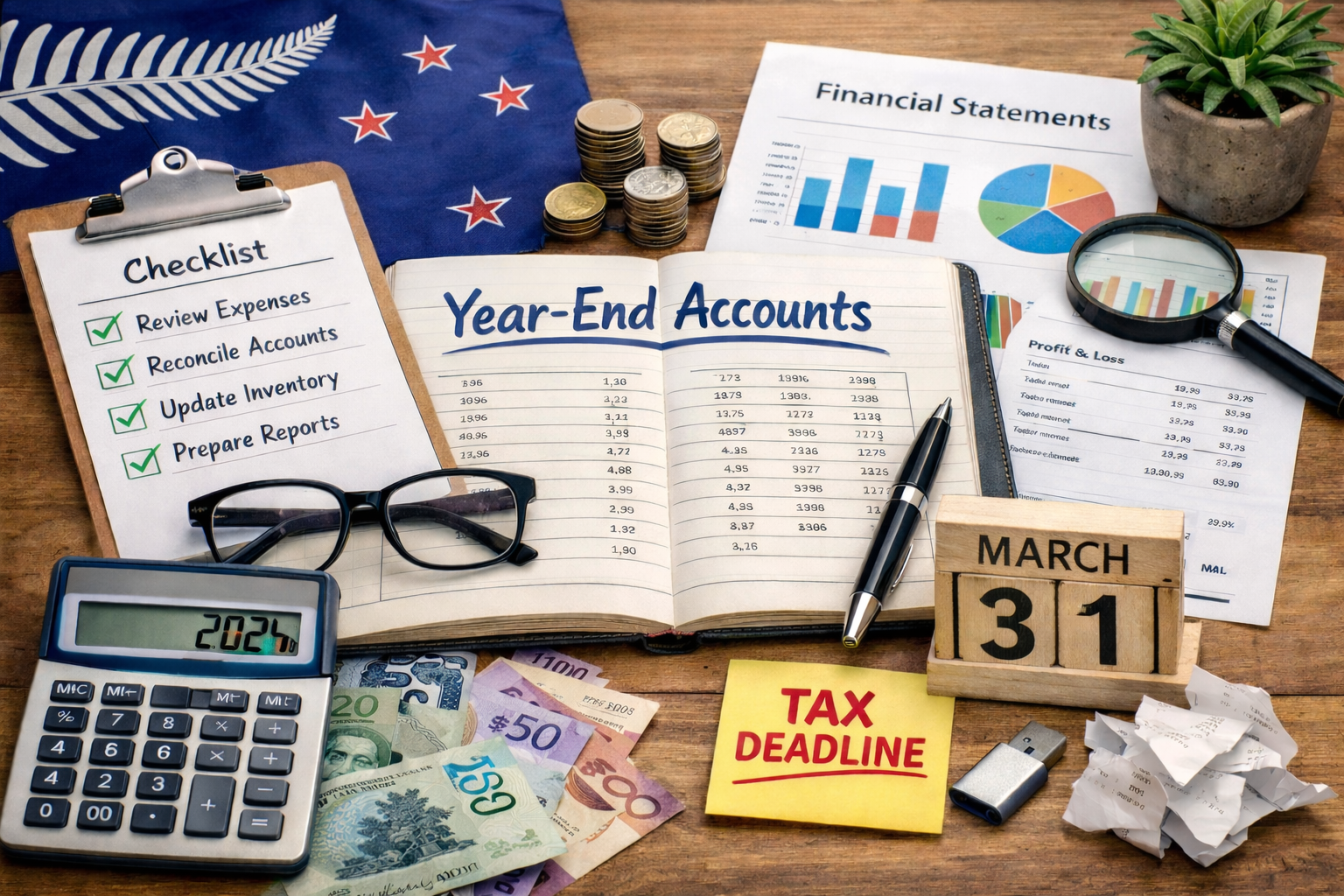
End of year tax tips As 31 March approaches, it is worth taking a moment to review your business’s financial position and ensure everything is in order before the end of the tax year. A little planning at this stage can make a meaningful difference—helping you claim legitimate deductions, avoid unnecessary tax costs, and start the new financial year with clean records. Below are several practical areas New Zealand business owners may wish to review before balance date. Review and write off unrecoverable debts If your business has invoices that are unlikely to be paid, consider whether they should be written off before 31 March. For tax purposes, bad debts are only deductible if they are formally written off in the accounting records before the financial statements are finalised. This generally means removing the debt from both the accounts receivable ledger and the general ledger. Simply identifying a debt as doubtful is not enough—the write-off must be recorded in the accounts. Consider charitable donations Donations made to approved charities before the end of the tax year may provide a tax benefit. Companies can generally claim a deduction for qualifying donations, while individuals may be entitled to a donation tax credit. In both cases, you will need to retain the donation receipt issued by the charity. For individuals, the donation tax credit can usually be claimed shortly after the end of the tax year once income details have been finalised. Check dividends and imputation credits If your company intends to pay dividends, it is important to review the balance of the imputation credit account (ICA). Ending the year with a debit balance can result in penalty tax, so careful management of imputation credits is important when planning dividend distributions. Where dividends are being considered, it may be worth reviewing the ICA position before the financial year closes. Review shareholder current accounts Overdrawn shareholder current accounts can give rise to tax implications, particularly if they remain unpaid for extended periods. Before year end, it may be sensible to review any shareholder balances and consider whether they should be repaid, cleared through salary or dividends, or charged interest where appropriate. Check elections relating to your business structure Certain tax elections are time-sensitive and often revolve around the balance date. These may include decisions about business structures or group arrangements, such as look-through company elections or joining a tax consolidated group. If structural changes are being considered, the end of the tax year is a good time to confirm whether any elections need to be made. Review trading stock Balance date is also an opportunity to review inventory. If you hold stock that is obsolete, damaged, or unlikely to be sold, it may be appropriate to write it down or dispose of it. Where stock is scrapped or written off before year end, this may allow a deduction to be recognised for tax purposes. Utilise tax losses within a group If your business operates within a group structure, tax losses in one company may be able to be offset against taxable profits in another. This can be achieved through mechanisms such as loss offset elections or subvention payments, provided the relevant ownership and timing requirements are met. Because these arrangements often require documentation and elections, it is best to consider them before 31 March. Taking a proactive approach Spending a little time reviewing these areas before balance date can help ensure your business is in a strong position heading into the new financial year. A year-end check can help identify deductions you are entitled to claim, ensure compliance with Inland Revenue rules, and reduce the risk of unexpected tax issues later on. If you are unsure whether any of these items apply to your business, it may be worth discussing them with us before the end of the financial year. Disclaimer: This post is a general discussion and does not constitute specific advice. Any concepts or ideas raised in this post should be discussed with your accountant and/or solicitor to ensure that all relevant matters are considered.